Eva Ramón Gallegos and the Fight Against HPV
A groundbreaking discovery two decades in the making
Every so often, a scientific breakthrough emerges that quietly reshapes what we believe is possible in medicine. For millions of women living with Human Papillomavirus (HPV), the work of Dr. Eva Ramón Gallegos may represent exactly that kind of turning point. A researcher from Oaxaca, Mexico, she has spent more than two decades pursuing a question that most of the medical world had left unanswered: could HPV actually be eliminated from the body? Her answer, delivered through years of painstaking research, is a resounding yes.
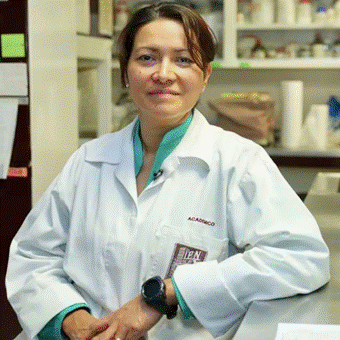
A Scientist Shaped by Curiosity and Dedication
Dr. Ramón Gallegos built her career at the intersection of biomedicine and biotechnology. She earned her undergraduate degree at the Universidad Veracruzana before deepening her expertise at Mexico’s prestigious Instituto Politécnico Nacional (IPN), where she completed a master’s degree in cytopathology and later a doctorate in chemical-biological sciences. A formative research residency at the University of Minho in Portugal expanded her horizons into molecular biotechnology and biophotonics — disciplines that would later prove central to her most celebrated work.
Since 2001, she has led the Environmental Cytopathology Laboratory at IPN’s National School of Biological Sciences in Mexico City, where she mentors graduate students while pushing the boundaries of non-invasive cancer treatment. Her specialty lies in finding gentler, smarter ways to fight disease — particularly cervical cancer linked to HPV.
Understanding the Problem: Why HPV Matters
HPV is the world’s most common sexually transmitted infection. With over 100 known strains and at least 14 linked to cancer, its reach is staggering — around 80% of women will contract some form of the virus during their lifetime. The World Health Organization identifies cervical cancer as the fourth most common cancer in women globally, and in Mexico specifically, it ranks as the second leading cause of cancer death among women.

For decades, medicine had no cure for active HPV infection. Prevention through vaccination — such as Gardasil — was the most powerful tool available. Once infected, patients could only wait, monitor, and manage. For Dr. Ramón Gallegos, that wasn’t good enough.
The Research Journey: Two Decades of Persistence
Her formal project launched in 2012 after she received a scholarship from Mexico’s national science council, CONACYT. But the intellectual groundwork had been laid years before. Her research centered on photodynamic therapy (PDT) — a technique that uses light-activated drugs to selectively destroy abnormal cells while leaving healthy tissue intact.
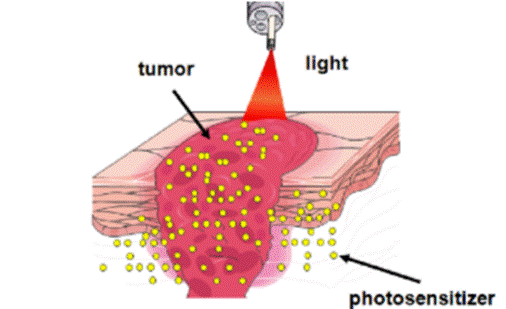
Photodynamic Therapy (PDT)
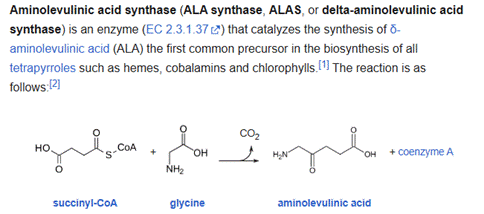
The process works like this: a photosensitizing agent called delta-aminolevulinic acid (5-ALA) is applied to the cervix. Over several hours, it converts into a fluorescent compound that accumulates in damaged or infected cells but clears quickly from healthy ones. Doctors then expose the area to a targeted light source. The compound absorbs the light and generates reactive oxygen molecules that destroy the compromised cells, a precise, almost elegant mechanism.
In an early phase of her research involving women across Mexico City, Oaxaca, and Veracruz, the results were already striking: HPV was eliminated in 85% of patients who had the virus without lesions, and in 85% of those who had both HPV and premalignant lesions. These figures alone would have been noteworthy. But Dr. Ramón Gallegos wasn’t finished.
The Breakthrough: 100% Eradication
In February 2019, the Instituto Politécnico Nacional announced results that caught the attention of scientists and journalists worldwide. In a refined second phase of the study — conducted with 29 women in Mexico City who received a higher concentration of 5-ALA over two sessions, 48 hours apart — HPV was completely eradicated in 100% of patients who had the virus without lesions. Among those with both HPV and premalignant lesions, 64.3% showed virus elimination. Even patients with lesions but no active HPV saw a 57.2% regression rate.
The announcement was fittingly made on February 11th — the International Day of Women and Girls in Science. The team of 18 researchers she led was itself a testament to inclusion: 14 of them were women.
Beyond HPV, the therapy also showed a remarkable secondary effect, eliminating pathogenic microorganisms like Chlamydia trachomatis (in 81% of patients) and Candida albicans (in 80%), while leaving beneficial bacteria largely intact.
What This Discovery Means
Dr. Ramón Gallegos has been careful to frame her results as a promising breakthrough rather than a definitive global cure, larger, peer-reviewed randomized controlled trials are still needed to confirm long-term efficacy and scalability. She has also spoken candidly about the systemic barriers she faced: underfunding, bureaucratic delays, and the chronic underinvestment in scientific research in Mexico.
Yet the significance of her work is hard to overstate. Conventional HPV-related treatments — surgical excisions, cryotherapy, biopsies — are invasive and can compromise cervical integrity and fertility. Photodynamic therapy is non-invasive, selective, and carries minimal side effects. If validated at scale, it could transform options available to women around the world, particularly in low- and middle-income countries where cervical cancer mortality remains devastatingly high.
“When I cure a woman, I’m going to be happy — and I was.”
— Dr. Eva Ramón Gallegos
That quiet satisfaction, earned through two decades of determined science, may one day be shared by millions.
Eva Ramón Gallegos • Instituto Politécnico Nacional • Photodynamic Therapy • HPV Research
 Unbedside Manners
Leave a comment