The BAFTA Tourette’s Incident and the Unequal Politics of Harm
February 27, 2026
It was supposed to be a night of triumph. John Davidson, the Scottish Tourette’s syndrome campaigner who has spent decades turning his most isolating condition into a vehicle for public education, had been invited to the 79th BAFTA Film Awards to celebrate “I Swear,” the critically acclaimed British film inspired by his life. The film had swept awards season. Its star, Robert Aramayo, would go on to claim the night’s Best Actor prize over Leonardo DiCaprio and Timothée Chalamet. It should have been, as BAFTA itself later acknowledged, “a night of celebration” for Davidson.

John Davidson
Instead, it became one of the most debated and uncomfortable nights in British broadcasting history — a night that exposed not merely a single editorial failure, but a web of interlocking questions about neuroscience, racial hierarchy, institutional responsibility, and the limits of empathy.
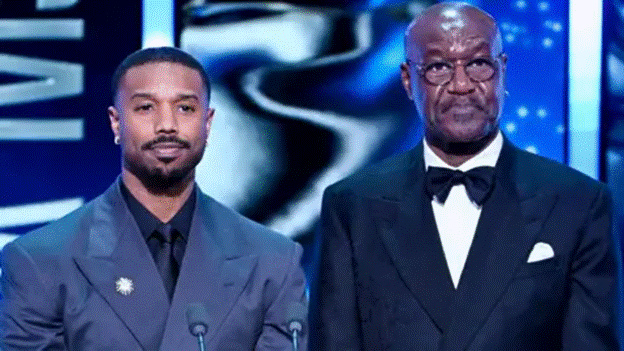
As Michael B. Jordan and Delroy Lindo, the celebrated Black stars of “Sinners,” took the stage at London’s Royal Festival Hall to present the first award of the night, a voice rang out from the audience some forty rows back. It was Davidson, and what he shouted was the N-word.

Michael B Jordan and Delroy Lindo
Jordan and Lindo paused. Then, with the kind of professionalism that no one should ever be required to demonstrate, they continued. The BBC, broadcasting the ceremony on a two-hour tape delay, aired the slur anyway. The homophobic tic Davidson had also directed at host Alan Cumming, it would later emerge, had been quietly edited out.
BAFTA and the BBC have since apologized. Davidson himself has expressed profound mortification and reached out privately to apologize to Jordan and Lindo. All the principal actors in this story behaved, ultimately, with more grace than the institutions around them. But the questions raised that night are not going away, and they deserve a serious reckoning.
What Is Tourette’s Syndrome — and What Is Coprolalia?
Tourette’s syndrome is a neurodevelopmental disorder characterized by sudden, repetitive, involuntary movements and vocalizations called tics. First described in the 19th century by French neurologist Georges Gilles de la Tourette, the condition typically appears in childhood and often diminishes in severity in adulthood — though for some, like Davidson, it remains a defining feature of daily life.
The symptom that seized public attention at the BAFTAs has a clinical name: coprolalia. Derived from the Greek for “dung” and “speech,” coprolalia refers to the involuntary utterance of obscene, offensive, or socially taboo words and phrases. It is, crucially, not the defining feature of Tourette’s — only an estimated 10 to 30 percent of those with the condition experience coprolalia, and its presence is not required for diagnosis. Yet it is the symptom most lodged in popular consciousness, partly because of dramatic media portrayals and partly because it is so viscerally arresting when it occurs.
Davidson himself has been explicit: the words that emerge from him during tic episodes are “literally the last thing in the world” he believes. “It is the opposite of what I believe,” he told Variety. “The most offensive word that I ticked at the ceremony is a word I would never use and would completely condemn if I did not have Tourette’s.” He has devoted his life to anti-racism and disability advocacy. He has been physically assaulted for his condition. He left the auditorium of his own accord that night because he was aware of the distress his tics were causing others.
This is not in dispute. The neurological reality of Tourette’s is well-established: tics are not chosen, and they carry no intentional meaning. But the very involuntariness of coprolalia raises a question that is, paradoxically, one of the most contested in the science of the condition.
Does the Brain Choose Its Worst Words?
Not everyone with coprolalia shouts racial slurs. This is not a trivial observation. It is, in fact, one of the most ethically and scientifically charged aspects of the condition, and it deserves a direct examination.
Researchers have noted that the specific content of coprolalia tics tends to reflect what a given individual, in a given cultural context, experiences as the most socially transgressive language possible. There is a well-documented phenomenon called “oppositional ticcing” — the involuntary compulsion to say the absolute worst thing one could say in a given environment. Tourette’s advocate Jess Thom, speaking in the aftermath of the BAFTA incident, described it as tics “searching out” the most upsetting expression for both the person and those around them. Davidson himself noted the phenomenon of “echolalia” — the triggering of tics by what one sees and hears — explaining that Alan Cumming’s joke about his own sexuality and a reference to Paddington Bear triggered homophobic tics; and the presence of two Black men on stage preceded the racial slur.
This produces a genuinely difficult question: if the brain is — even non-consciously — selecting the most socially violating content available to it, does the language that a person has absorbed and categorized as “maximally offensive” shape what emerges? The clinical consensus remains that tics themselves are involuntary. But the lexicon from which the brain draws cannot be entirely independent of the person’s lifetime of language exposure and socialization. A person who has genuinely never encountered a racial slur, who has no mental representation of such a word, cannot tic it. The word must, at some level, exist in the neural architecture.
This does not make Davidson morally culpable. It does not mean the tic was intentional. Intentions and neurological processes are different things. But it does suggest that the specific vocabulary of coprolalia is not random — that the brain is drawing from a culturally and personally inflected reservoir of what counts as “unsayable.” In societies where racial slurs are among the most charged words in the language, they will therefore recur in the tics of coprolalia sufferers who have internalized their power as transgressive, even if they find them personally abhorrent.
This understanding actually deepens our sympathy for Davidson, who has lived knowing that his tics could betray everything he stands for. It does not diminish the impact on Jordan and Lindo. Both of these things are true simultaneously, and any honest engagement with the BAFTA incident must hold them in tension.
The BBC’s Editing Decision: An Act of Differential Protection
Here is what we know about the BBC’s editorial choices that night, and they are damning in their specificity.
The BBC broadcast the BAFTA ceremony on a two-hour tape delay. This is not live television. A two-hour window is more than sufficient time for editorial review, particularly when the broadcaster knew in advance that Davidson — a man who has made four previous documentaries with the BBC about his Tourette’s — would be in the room. Multiple other elements of the broadcast were edited: the BBC cut an award presenter saying “Free Palestine,” a political statement the corporation deemed inappropriate for broadcast. The homophobic tic that Davidson directed at Alan Cumming was also removed.
The N-word, directed involuntarily at two Black men on a public stage, was not.
BBC head of content Kate Phillips later acknowledged in a staff email that a second racial slur had been edited out during production. The N-word, she said, “was aired in error and we would never have knowingly allowed this to be broadcast.” That acknowledgment makes the failure worse, not better: the BBC had an editorial protocol in place, that protocol was applied to protect some people and not others, and it failed specifically in the case of the word with the longest and most painful history of anti-Black dehumanization in the English language.
The pattern of what was edited and what was not tells a story. Alan Cumming — a white Scottish entertainer who is openly gay — was protected. His dignity, and by extension his ability to continue hosting without the taint of a homophobic slur attached to his name, was preserved. Jordan and Lindo — two Black men who were guests at a ceremony, on a stage, with cameras pointed at them — were not extended the same protection. They could not react. They could not defend themselves. They could not step away. The professional constraints of a live television moment meant they were required to absorb the moment in public and in silence, their poise serving as both their shield and their cage.
Delroy Lindo, speaking to Vanity Fair at a post-ceremony party, said he and Jordan “did what we had to do” and that he wished someone from BAFTA had spoken to them after the incident. That statement — measured, dignified, grieved — carries a weight that should not be allowed to dissipate. Two Black men, world-renowned artists, were subjected to a racial slur on a public stage, aired to millions on national television, and the organization responsible for the evening found time to thank them for their “incredible dignity and professionalism” before it found time to ensure that dignity was protected.
The Power Asymmetry of Public Racial Harm
There is a structural inequality embedded in incidents of this kind that must be named clearly. When a racial slur is directed at a Black person in a public context, that person’s ability to respond is almost always constrained by the same professionalism that society demands of them. To react visibly is to be characterized as “difficult” or “oversensitive.” To absorb it silently is to allow the harm to pass unchallenged. This is a double bind with a long history, and it is not incidental to the BAFTA incident — it is central to it.
Jordan and Lindo were not backstage when the tic occurred. They were not in the audience with the option to leave or look away. They were the presenters — standing at a podium, faces lit by television cameras, mid-sentence. The architecture of the moment stripped them of every ordinary means of response available to someone subjected to racial abuse. And then, when they responded with grace, they were praised for it — which is a kind of praise that should make anyone uncomfortable, because it converts their lack of options into a moral achievement.
Compare this to the position of Alan Cumming. The homophobic tic aimed at him was edited out before broadcast. The millions of viewers who watched the BBC ceremony did not hear it. His reputation was not altered by association. He retained full control over his own public narrative that night. This is not to suggest that homophobic language is less serious than racist language, or that Cumming’s protection was unwarranted — it is to suggest that the same protection was owed to Jordan and Lindo, was available within the BBC’s two-hour editing window, and was not deployed.
The question “why not?” has not been fully answered. The BBC has described it as an error. But errors in broadcasting tend to reflect the implicit hierarchies of the organizations that make them, and an error that consistently falls on the side of under-protecting Black people is not a neutral accident — it is the shape of a structural problem.
Holding Complexity: Empathy for Davidson, Accountability for Institutions
The most important thing to resist in this conversation is the false binary: that we must either fully protect Davidson’s dignity as a disabled person or fully acknowledge the harm done to Jordan and Lindo. These are not competing propositions. They are both true, and they demand different things from different parties.
Davidson is not morally culpable for his tics. He has said so, and the neuroscience supports him. He left the auditorium voluntarily, has expressed deep mortification, and has reached out to apologize privately. His life’s work is the antithesis of the language his condition forces from him. The public reaction that has included suggestions that his tics reveal unconscious racism — that “I need to stay inside” or “I am racist deep down” — misunderstands the neurological reality of coprolalia and has caused additional pain to a man who is himself a victim of his condition. That reaction is wrong, and correcting it matters.
And yet. The institutions around Davidson — BAFTA and the BBC — made choices. Inviting Davidson was a choice. Announcing his presence to the auditorium was a choice (and arguably the right one). Pre-informing the television audience of the possibility of offensive language was a choice. Editing the homophobic tic was a choice. Not editing the racial slur was a choice, even if an inadvertent one. Leaving the ceremony on iPlayer with the slur audible for fifteen hours before removing it was a choice. Each of these choices reflects institutional judgment, and several of them reflect institutional failure.
BAFTA has since launched what it describes as a “comprehensive review.” The BBC has apologized. Both organizations say they will learn from the incident. These are necessary but not sufficient responses. The review that BAFTA owes its members — and the public — must confront a specific question: in the planning process, who was consulted? Were Jordan and Lindo — or any of the Black artists invited to present that evening — informed in advance that a man with coprolalia would be in the audience and that racial slurs were among the possible tics? Lindo’s statement suggests they were not. If that is true, it represents a fundamental failure of inclusion: the discomfort of some was considered more carefully than the safety of others.
The Broader Politics of Tourette’s
The BAFTA incident arrives at a particular moment in the politics of Tourette’s. “I Swear” has done what great advocacy art is supposed to do: it has shifted public understanding. The Tourettes Action charity reports an unprecedented wave of people engaging with the condition’s reality — people who had previously known it only through caricature now confronting its actual weight. Davidson has described being assaulted, isolated, and socially imprisoned by his tics. The film’s success represented a genuine cultural recalibration.
The BAFTA night, for all its pain, may ultimately advance that education — not because racial slurs are pedagogically useful, but because the conversation it has forced is now unavoidable. Millions of people who knew little about coprolalia now understand that it is real, that it is not shamming, and that it causes tremendous suffering to those who live with it. The Tourette’s community has been vocal about this silver lining even as it mourns the circumstances.
But the politics of Tourette’s cannot be separated from the politics of race. The condition does not exist in a vacuum; it operates within social contexts that have existing hierarchies of harm. When coprolalia draws on the most powerful taboo words in a culture, it will draw on racial slurs in a society where racial slurs carry the deepest history of violence and dehumanization. This is not Davidson’s fault. It is also not a reason to treat the harm to Jordan and Lindo as merely collateral. Both things must be named, and named plainly.
What a Reckoning Looks Like
The BAFTA incident has no satisfying resolution, and we should resist the pressure to find one. John Davidson is not a racist, and he is also not entirely without the capacity to cause racial harm. The BBC made an error, and that error was not neutral. Jordan and Lindo conducted themselves with extraordinary grace, and they should never have been required to. All of this is true.
What a genuine reckoning requires is this: that institutions like BAFTA and the BBC develop protocols that extend equal consideration to all of the people they put in front of cameras. That means consulting presenters — especially Black presenters — before events where the possibility of racial slurs has been identified and accepted as a risk. That means applying editing resources uniformly, rather than in ways that protect some categories of people more carefully than others. And that means being honest, afterwards, about why the error fell the way it did.
It also requires, at the level of public discourse, that we become capable of holding two sympathies simultaneously: one for a man whose disability has sentenced him to a life of inadvertent transgression, and one for two men who were subjected to a racial slur on national television with nowhere to go and nothing they could say. Empathy is not a finite resource that must be rationed between the disabled and the racially harmed. We have enough of it — if we are willing to use it carefully.
The night that was supposed to celebrate “I Swear” — a film about the isolation and misunderstanding Tourette’s creates — instead became an illustration of exactly that isolation and misunderstanding, played out in real time, in front of millions. The only question now is whether the institutions responsible for that illustration will do the work that the film itself was pointing toward.
Key Terms
Coprolalia: The involuntary utterance of obscene, offensive, or socially taboo words and phrases. A symptom that affects 10–30% of people with Tourette’s syndrome. Derived from the Greek kopros (dung) and lalia (speech).
Echolalia: The involuntary repetition or imitation of words and sounds heard from others. A tic trigger in which the person with Tourette’s is set off by language in their environment.
Oppositional Ticcing: A described phenomenon in which the brain involuntarily produces the most socially transgressive utterance available to it in a given context — not as a reflection of the person’s beliefs, but as a neurological escalation toward maximum taboo.
 Unbedside Manners
Leave a comment