Origins and Historical Context
The Controlled Substances Act (CSA) was enacted in 1970 as Title II of the Comprehensive Drug Abuse Prevention and Control Act, signed into law by President Richard Nixon. Its passage came at a pivotal moment in American history; the late 1960s were marked by widespread social upheaval, the counterculture movement, and a surge in recreational drug use that alarmed the federal government and much of mainstream America. The Vietnam War was producing thousands of soldiers exposed to heroin. College campuses were awash in psychedelics and marijuana. Nixon, who would formally declare a “War on Drugs” in 1971, viewed drug use as both a public health crisis and, arguably, a political threat, a destabilizing force he associated with the antiwar left and racial minorities. Decades later, Nixon aide John Ehrlichman would controversially confirm in a 1994 interview that the drug war was partly designed to criminalize and disrupt communities Nixon saw as political enemies.
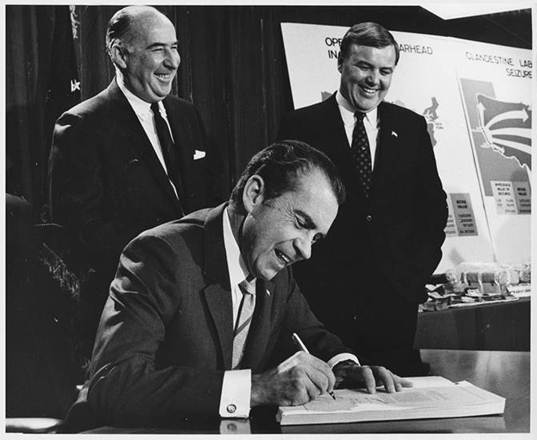
President Richard Nixon signing The Controlled Substances Act 1970
Before the CSA, federal drug regulation was fragmented across multiple statutes, the Harrison Narcotics Tax Act of 1914, the Marihuana Tax Act of 1937, and various amendments. The CSA consolidated all of these into a single, comprehensive federal framework and gave the federal government sweeping authority over virtually every substance with any potential for abuse or medical use.
What the CSA Actually Does
The CSA establishes a federal system for regulating the manufacture, distribution, importation, possession, and prescription of certain drugs and chemical compounds. At its core, it creates five schedules of controlled substances, classifying drugs based on two criteria: their accepted medical use and their potential for abuse or dependence.
Schedule I substances are defined as having no currently accepted medical use and a high potential for abuse. This category includes heroin, LSD, psilocybin, MDMA, and — controversially — marijuana, which remains Schedule I at the federal level despite being legal in dozens of states and used medically by millions of Americans. The placement of marijuana in Schedule I has been one of the most heavily criticized aspects of the entire law.
Schedule II includes drugs with accepted medical uses but high potential for abuse and severe physical or psychological dependence. This is where many pain patients live their lives, medically speaking. Schedule II contains oxycodone (OxyContin, Percocet), hydrocodone (Vicodin, now rescheduled from III to II in 2014), morphine, fentanyl, methadone, Adderall, Ritalin, and cocaine (yes — cocaine has a narrow Schedule II medical use as a topical anesthetic). These are among the most tightly regulated substances in American law.
Schedule III includes anabolic steroids, ketamine, buprenorphine (in some formulations), and testosterone. Schedule IV contains benzodiazepines (Xanax, Valium, Klonopin), tramadol, and sleep medications like Ambien. Schedule V includes preparations with small amounts of codeine, like cough syrups.
The scheduling system is not static; the Drug Enforcement Administration (DEA) and the Department of Health and Human Services share authority to reschedule substances, though this process is notoriously slow, politically influenced, and resistant to scientific revision. The persistent Schedule I status of marijuana, maintained for more than fifty years despite mountains of evidence of medical utility, is the most glaring example of this institutional inertia.
The CSA and Medical Prescribers: A System of Fear
This is where the law begins to cause serious, measurable harm to both doctors and patients.
Under the CSA, physicians who prescribe Schedule II controlled substances must register with the DEA, maintain meticulous records, follow strict prescribing limits, and operate under a regulatory framework that treats the act of prescribing a pain medication as an inherently suspicious activity requiring constant justification. A physician’s DEA registration — the license to prescribe controlled substances — can be suspended or revoked based on findings that they prescribed “outside the usual course of professional practice” or “without a legitimate medical purpose.” These phrases sound reasonable in the abstract, but in practice they are elastic enough to ensnare physicians exercising legitimate clinical judgment.
The DEA is a law enforcement agency, not a medical agency. It employs investigators with no medical training to evaluate the clinical decisions of board-certified physicians. This creates a profound institutional mismatch. A pain management specialist who makes a good-faith judgment that a patient with advanced cancer, failed back surgery syndrome, or complex regional pain syndrome requires high-dose opioids may find themselves under criminal investigation — not because their decision was medically unsound, but because it exceeded statistical norms or triggered a red flag in a database.
The consequences for physicians are catastrophic and career-ending. Criminal prosecution under the CSA for “illegal distribution” of controlled substances carries the same statutory penalties as street-level drug dealing. Physicians have been sentenced to decades in federal prison. The DEA’s use of the “pill mill” prosecution model, which accelerated dramatically in the 2010s in response to the opioid crisis, has resulted in the prosecution of physicians whose patients were later determined to be addicts or diverters — circumstances the physician had no reliable means of detecting at the time of prescribing.
The psychological effect on the broader prescribing community has been devastating. Surveys of pain management physicians, oncologists, and primary care providers consistently show that fear of DEA investigation is one of the primary factors driving underprescription of opioid pain medication. Physicians are rationing care — not based on what patients need, but based on what the law will tolerate. This is sometimes called opiophobia, and it is now embedded in the culture of American medicine in ways that would have been unimaginable to physicians practicing before the CSA’s passage.
How the CSA Harms Patients
The harm to patients is direct, ongoing, and in many cases life-altering or fatal — though this harm receives far less public attention than opioid overdose deaths, because patient suffering is invisible and underdiscussed.
Chronic pain patients including people living with cancer, sickle cell disease, arachnoiditis, degenerative disc disease, neuropathy, rheumatoid arthritis, Ehlers-Danlos syndrome, and hundreds of other conditions depend on controlled substances not to get high, but to function. For them, opioid medications may represent the difference between working and disability, between independence and institutional care, between a life worth living and one defined entirely by suffering.
Under the current regulatory environment shaped by the CSA and its associated enforcement apparatus, including CDC prescribing guidelines that insurers and pharmacies have treated as mandates, millions of these patients have had their medications reduced, tapered, or discontinued entirely, not because their condition changed, but because their doctor became afraid. The consequences include: uncontrolled pain, loss of employment, breakdown of family relationships, inability to perform basic activities of daily living, and a well-documented increase in suicide among undertreated chronic pain patients.
Pharmacies, which are also regulated under the CSA, have increasingly refused to fill legitimate prescriptions from licensed physicians for Schedule II medications, particularly in high quantities. This has created a situation where a patient holds a valid prescription from a licensed physician but cannot access their medication because a pharmacy technician or chain compliance officer has made a unilateral decision that the prescription looks suspicious. The CSA created the legal architecture that makes this possible.
The law also disproportionately harms poor patients, patients of color, elderly patients, and patients in rural areas. Wealthier patients can afford pain management specialists, concierge physicians, and legal representation. Poorer patients cannot. Black and Hispanic patients are documented to be systematically underprescribed pain medication compared to white patients with identical diagnoses — a disparity with complex causes, but one that the CSA’s punitive framework has done nothing to correct and may have worsened.
Sociological and Legal Impact
The sociological impact of the CSA cannot be overstated. It fundamentally reframed the relationship between medicine and law enforcement in the United States. Before the CSA, a physician’s prescribing decisions were primarily regulated by medical licensing boards composed of other physicians. After the CSA, a federal law enforcement agency gained coequal authority to second-guess and criminalize medical decisions. This is a radical transformation with no meaningful parallel in other developed nations.
The CSA also contributed to the mass incarceration crisis. Mandatory minimum sentences attached to drug offenses, many tied to the schedules the CSA created, resulted in millions of Americans, disproportionately Black and Hispanic men, serving lengthy federal sentences for nonviolent drug offenses. While chronic pain advocates and street-level drug enforcement are often treated as separate issues, they share a common legal ancestor in the CSA and its punitive philosophy.
The law further embedded a moral framework around drug use that conflates addiction, a medical condition, with criminality, and that has consistently prioritized punishment over treatment. This framework has proven extraordinarily resistant to reform despite decades of evidence that it does not reduce drug use, does not reduce addiction rates, and does not improve public health outcomes.
Does the CSA Treat Prescribers Differently From Drug Dealers?
On paper, yes. In practice, the distinction is narrower than most people realize and is eroding.
The CSA formally creates a category of lawful distribution through licensed prescribers, pharmacies, and manufacturers. A physician with a DEA registration prescribing oxycodone to a pain patient is, legally, in a completely different category from a dealer selling the same drug on a street corner.
But prosecutorially, the distance between these categories has collapsed in disturbing ways. The “Drug Dealer Doctor” prosecution theory, which the DEA and Department of Justice have used aggressively since the early 2000s, applies the same criminal statutes — including 21 U.S.C. § 841, which prohibits distribution of controlled substances — to physicians who prescribe “outside the usual course of professional practice.” This same statute is used to prosecute cartel members and street dealers.
Physicians convicted under these theories have received sentences comparable to or longer than sentences for non-physician drug traffickers. Dr. William Hurwitz, a pain management physician, was initially sentenced to 25 years in federal prison, a sentence later reduced on appeal but still devastating. Across the country, physicians have served years in federal prison under the same statutory framework used to prosecute drug kingpins. The Supreme Court’s 2022 decision in Ruan v. United States provided some relief by clarifying that the government must prove a physician knowingly prescribed outside legitimate medical practice, a subjective rather than purely objective standard, but the prosecutorial machinery remains largely intact.
The moral asymmetry here is significant and deeply troubling: a physician who dedicates their career to treating suffering patients, makes good-faith decisions under difficult clinical conditions, and loses a patient to overdose faces the same criminal statutes, and sometimes harsher sentences, than individuals who sell drugs with no pretense of medical purpose.
Should the CSA Be Repealed or Rewritten?
The case for fundamental reform is overwhelming.
Outright repeal without replacement would create genuine problems — some federal framework for regulating dangerous substances, preventing diversion, and controlling manufacturing is reasonable and necessary. No serious policy analyst advocates for a completely unregulated drug supply.
But the CSA as it stands reflects the priorities and prejudices of 1970, and it has proven catastrophically poorly suited to the complexities of modern medicine, addiction science, and public health. A serious rewrite would need to accomplish several things.
First, medical scheduling decisions should be made by medical and scientific bodies, not law enforcement agencies. The DEA’s scheduling authority should be transferred to a body with actual medical expertise — the FDA, NIH, or a newly created entity — with the DEA retaining authority over diversion and trafficking, not over the medical appropriateness of prescribing decisions.
Second, the criminal prosecution of physicians for good-faith prescribing decisions should require a much higher evidentiary standard than currently exists. The chilling effect of DEA enforcement on legitimate pain treatment is a public health catastrophe. The law should make clear, in precise statutory language, that clinical judgment exercised in good faith by a licensed physician cannot form the basis of a criminal prosecution absent clear evidence of knowing participation in diversion or fraud.
Third, the scheduling of marijuana as Schedule I — a classification that has been scientifically untenable for decades — should be corrected immediately. The federal government’s own Health and Human Services Department recommended rescheduling in 2023, yet the process continues to grind slowly through bureaucratic channels.
Fourth, mandatory minimum sentences tied to drug schedules should be abolished. The empirical evidence that mandatory minimums deter drug use or trafficking is weak; the evidence that they have caused enormous human suffering through mass incarceration is overwhelming.
Fifth, the law should formally establish patient rights in the context of controlled substance prescribing — the right to pain treatment, the right to have prescriptions filled at licensed pharmacies, and protection against arbitrary denial of medically necessary medication by insurance companies, pharmacy chains, or other intermediaries acting under the color of CSA compliance.
Conclusion
The Controlled Substances Act was born of a specific historical moment — political anxiety, racial animus, and a genuine but poorly theorized public health concern about drug abuse. In the more than fifty years since its passage, it has shaped American medicine, criminal justice, and public health in ways that have caused immeasurable suffering. It has given law enforcement authority over medical decision-making, turned physicians into suspects, abandoned millions of pain patients, and failed to achieve its stated goal of reducing drug abuse.
For chronic pain patients and their advocates, the CSA is not an abstraction. It is the legal foundation of the system that has denied them medication, frightened their doctors, closed their clinics, and in too many cases contributed to their deaths — by undertreated pain, by suicide, or by the irony of forcing them toward unregulated street drugs that are far more dangerous than the prescribed medications they were denied. That is a policy failure of the first order, and it demands not minor adjustment but serious, courageous rethinking.
 Unbedside Manners
Leave a comment