What They May Not Be Telling Us
A Clinical Analysis for Entertainment Purposes
By a Retired MD, PhD (Biochemistry) | Orthopedic & Spine Surgery | Chronic Pain Management | Medical Aesthetics
⚠ MEDICAL DISCLAIMER: This article is produced for ENTERTAINMENT PURPOSES ONLY. The author is a retired MD and PhD in Biochemistry, with specialization in Orthopedic Surgery, Spine Surgery, Chronic Pain Management, and Medical Aesthetics. Nothing herein constitutes medical advice, diagnosis, or treatment. All analysis is speculative, based solely on publicly available observations, and offered as an intellectual exercise in clinical reasoning and differential diagnosis. No private medical records have been accessed or used. All individuals are presumed healthy unless proven otherwise by their own treating physicians.
Doctors notice things. It is an occupational habit that never fully retires with the practitioner. And over the past several years, a growing number of physicians — watching the same publicly available footage, the same press conferences, the same photographs as everyone else — have been quietly exchanging observations that the mainstream media has largely declined to discuss with clinical rigor.
This article attempts to do what a responsible multidisciplinary medical team would do: look at the observable signs, organize them by body system, apply evidence-based clinical reasoning, and arrive at the most coherent explanation the evidence supports. It is offered as an intellectual exercise in differential diagnosis — not as a definitive medical conclusion, not as a political statement, and emphatically not as a substitute for proper medical evaluation.
What the evidence suggests is not one single disease. It is a constellation — a multi-system picture that, when assembled carefully, tells a coherent and concerning story.
— ✦ —
The Heart: What the Swollen Ankles and Bruised Hands Reveal

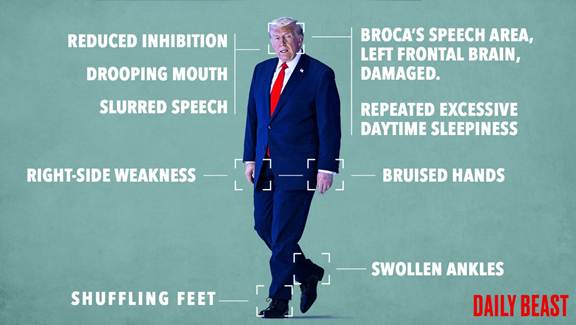
Start with the ankles. Bilateral pitting edema — visible swelling in both lower legs simultaneously — is not a cosmetic curiosity. In clinical medicine, it is a sign that demands explanation. When an elderly male patient presents with it, the differential includes cardiac failure, venous insufficiency, renal dysfunction, or medication side effects. The key word is bilateral: unilateral swelling points to a local problem; bilateral swelling points upward, toward the whole-body circulation.

In a patient with Donald Trump’s documented profile — central abdominal obesity, a diet reported to be heavy in saturated fat and processed food, advanced age, and male sex — the most probable cardiac explanation is right-sided heart failure secondary to longstanding hypertensive cardiovascular disease. The heart, overworked for decades, begins to lose the battle of fluid management. The result pools in the legs.
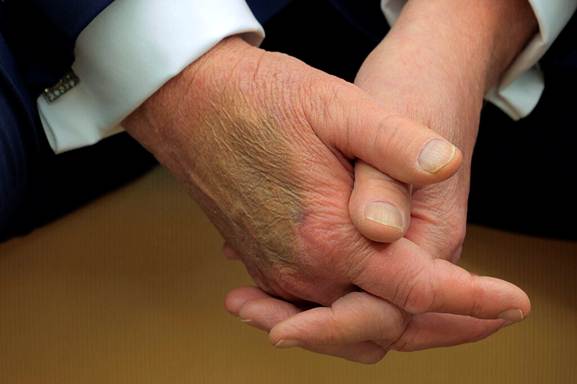
Then there is the bruising. Recurring discoloration on the dorsal surface (the back) of the hands, sometimes appearing in photographs and reportedly covered with heavy cosmetic product. To a clinician, this is a recognizable pattern: it is what repeated IV access looks like. The dorsum of the hand is a standard venipuncture site. In an elderly patient with fragile veins, or one taking anticoagulants — blood thinners commonly prescribed for atrial fibrillation — the bruising from regular IV access is inevitable, dramatic, and persistent. The concealment is itself medically significant: it suggests an active effort to hide evidence of ongoing intravenous medical treatment.
“The concealment is itself medically significant: it suggests an active effort to hide evidence of ongoing intravenous medical treatment.”
— ✦ —
The Brain: Gait, Speech, and the Signs of Neurological Decline
Neurologists have a saying: watch them walk in. Gait, the way a person moves through space, is one of the most diagnostically rich sources of information in clinical medicine. And the publicly available footage of Trump in recent years reveals a pattern that movement disorder specialists would find notable: shortened stride length, a forward-flexed posture, reduced arm swing, and visible difficulty navigating inclines.
This constellation is called Parkinsonian gait. It does not necessarily mean Parkinson’s disease. A clinically identical presentation emerges from Vascular Parkinsonism — a condition caused by multiple small strokes or ischemic lesions affecting the basal ganglia, the deep brain structures that coordinate movement. Critically, vascular Parkinsonism tends to affect the lower body first: gait and balance deteriorate while the hands may be spared the classic pill-rolling tremor. And it almost always co-occurs with cognitive impairment, because the same vessels feeding the motor circuits also feed the frontal lobes.

The speech patterns deserve equal attention. Verbal perseveration — the compulsive repetition of words, phrases, or themes despite the absence of a justifying stimulus — is a reliable clinical sign of frontal lobe executive dysfunction. Word-finding failures, phonemic substitutions, mid-sentence topic drift: these are not the normal stumbles of public speaking. They are the specific fingerprints of a central nervous system process affecting language networks and executive control.
— ✦ —
Sleep Architecture: The 3 AM Tweets and the Afternoon Naps
The paradox is well documented: late-night social media activity timestamped well past midnight, combined with visible daytime somnolence — the nodding off during official meetings and ceremonies that has been captured on camera multiple times. To a sleep medicine physician, this is not erratic behavior. It is a textbook presentation of severe, untreated Obstructive Sleep Apnea.
OSA occurs when the upper airway collapses during sleep, blocking airflow. The brain triggers micro-arousals to restore breathing — potentially hundreds of times per night — preventing the patient from ever achieving the deep, restorative sleep stages that the body requires. The result is chronic nocturnal oxygen deprivation and profound daytime somnolence. And the sequelae extend far beyond fatigue: OSA strains the cardiovascular system, damages frontal white matter and hippocampal circuitry, disrupts hormonal regulation, and creates the exact pattern of daytime sleep attacks we observe.
The likely response — stimulant medications to maintain daytime wakefulness — adds its own layer of risk. Amphetamine-class drugs in the context of unmanaged OSA and probable cardiovascular disease elevate arrhythmia risk, elevate blood pressure, and — critically — can exacerbate paranoia, hostility, impulsivity, and grandiosity.

— ✦ —
The Mind: Confabulation, Disinhibition, and the Frontal Lobe
This is the territory where clinical observation requires the greatest care and the greatest honesty. The behavioral patterns that have become increasingly prominent — the confident assertion of easily disproved facts, the perseverative return to fixed themes, the escalating hostility and retributive focus, the apparent inability to modulate emotional responses — have a specific neurological explanation.
Confabulation is not lying in the deliberate sense. It is a memory phenomenon in which the brain, facing a gap, spontaneously generates plausible information to fill it — without awareness that the generated information is fabricated. The person is not performing deception; they are experiencing a memory circuit failure that substitutes construction for recall. It is seen in early and mid-stage dementia, in frontal lobe syndromes, and in vascular cognitive impairment.
Frontal disinhibition explains the rest. The prefrontal cortex is the brain’s executive brake system — it modulates impulsive, reactive, and emotional outputs from deeper structures. When it is damaged by ischemia, neurodegeneration, or chronic hypoxia, the brake is released. Pre-existing personality traits — whatever their nature — are not replaced; they are amplified and rendered context-blind. The filter is gone.
“Pre-existing personality traits are not replaced by frontal damage — they are amplified and rendered context-blind. The filter is gone.”
— ✦ —
The Treatment Nobody Is Discussing
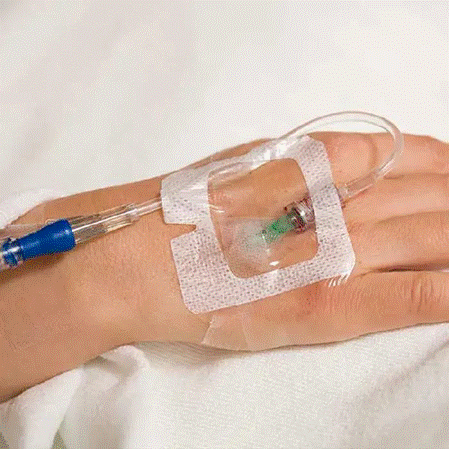
The FDA has approved two revolutionary Alzheimer’s therapies in recent years — Lecanemab (Leqembi) and Donanemab (Kisunla) — that work by clearing amyloid plaques from the brain via intravenous infusion. Lecanemab requires infusions every two weeks. Both drugs mandate a rigorous monitoring protocol: multiple MRI brain scans, and regular cognitive assessments using validated instruments such as the MMSE and MoCA, to detect a potentially life-threatening side effect called ARIA — amyloid-related brain swelling and microhemorrhage.


These monitoring requirements provide the most coherent medical explanation for reports of repeated private cognitive assessments. The bruising on the dorsal hands provides the most coherent evidence of ongoing IV access on a regular schedule. The concealment with makeup provides the behavioral evidence of deliberate effort to hide this treatment from public view.
If this hypothesis is correct, the prognosis follows the natural history of mixed dementia: a step-wise decline punctuated by vascular events, each producing a measurable drop in function, toward increasing incapacitation over a period of years. Anti-amyloid therapy may slow the Alzheimer’s component — it cannot reverse what has already occurred.
— ✦ —
What This Means — And What to Watch For
A leader with unmanaged obstructive sleep apnea, probable cardiovascular disease, frontal lobe disinhibition, and possible active dementia treatment presents governance risks with no parallel in ordinary physical illness. Impulsive decisions in high-stakes environments. Inability to integrate contrary advice. Confabulated strategic reasoning acted upon with full conviction. These are not hypothetical concerns. They are the documented functional consequences of frontal lobe dementia in any patient — regardless of who that patient is.
Watch, in the coming months, for increasing frequency of visible word-finding failures in unscripted settings. Growing reliance on teleprompter for remarks that previously required none. Any frank fall or neurological event in public. Increasing delegation of previously personal decisions. Any sudden absence from public view following what is described as a minor illness. These are the clinical milestones of progression.
The governed deserve transparency about the cognitive capacity of those who govern them. Not because of politics, but because the decisions made in that office carry consequences that extend to every human being on earth. That is not a medical opinion. It is simply true.
— ✦ —
⚠ MEDICAL DISCLAIMER: This article is produced for ENTERTAINMENT PURPOSES ONLY. The author is a retired MD and PhD in Biochemistry, with specialization in Orthopedic Surgery, Spine Surgery, Chronic Pain Management, and Medical Aesthetics. Nothing herein constitutes medical advice, diagnosis, or treatment. All analysis is speculative, based solely on publicly available observations, and offered as an intellectual exercise in clinical reasoning and differential diagnosis. No private medical records have been accessed or used. All individuals are presumed healthy unless proven otherwise by their own treating physicians.
This blog article is an accompaniment to a six-part medical analysis video script series covering cardiovascular, neurological, sleep, psychiatric, treatment, and prognostic evidence. For entertainment purposes only.
 Unbedside Manners
Leave a comment