There are scientists who change the world quietly, their discoveries rippling outward long after their names have faded from public memory. Percy Lavon Julian was not meant to be forgotten — and thankfully, he isn’t. His story is one of breathtaking intellect, unyielding determination, and a refusal to let the world’s smallness limit the size of his dreams.
A Young Mind Reaches Upward
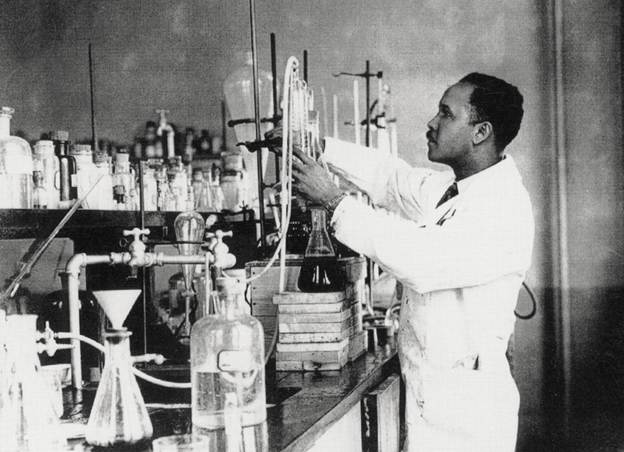
Percy Julian was born on April 11, 1899, in Montgomery, Alabama — a time and place that offered little encouragement to a Black child with ambitions. His grandfather had been enslaved, and the educational opportunities available to young Percy were painfully limited. Montgomery’s public schools for Black students ended at eighth grade. That could have been the end of the story. Instead, it was just the beginning.
His parents, James and Elizabeth Julian, made sure their six children understood that education was non-negotiable. Percy enrolled at DePauw University in Greencastle, Indiana, in 1916, but he arrived underprepared due to his inadequate schooling. He tackled high school subjects at night while excelling in his college courses during the day. The determination was extraordinary. By 1920, he graduated valedictorian of his class.
He went on to earn a master’s degree from Harvard University and, after facing repeated rejection from Ph.D. programs in the United States, rejections rooted not in his qualifications but in his race, he traveled to Vienna, Austria. At the University of Vienna, he earned his doctorate in chemistry in 1931 under the renowned chemist Ernst Späth. Julian returned home armed with world-class expertise and a fire that racism had only made burn brighter.
The Harvard Chapter — and Its Bitter Aftermath
Percy Julian’s time at Harvard is a study in contradictions. He was brilliant enough to be welcomed into one of the world’s most prestigious institutions, yet the racism of the era ensured he was never truly welcomed at all. Despite his exceptional record, Harvard declined to offer him a teaching fellowship, fearing that white students from the South would object to being taught by a Black man.
It was a rejection that stung — but it did not stop him. After returning from Vienna, Julian joined the faculty at DePauw, where he and colleague Josef Pikl achieved one of the most celebrated feats in organic chemistry: the first synthesis of physostigmine, a compound used to treat glaucoma. The accomplishment silenced doubters and announced Julian’s genius to the scientific world.

Physostigmine
Navigating Racism at Every Turn
Even as his star rose, racism followed Julian like a shadow. When he was hired as director of research at the Glidden Company in Chicago in 1936, a historic appointment that made him one of the first Black scientists to lead a major industrial research lab, the city of Oak Park refused to allow him and his family to purchase a home there. Twice, their new home was attacked: first with a smoke bomb, then with dynamite. Percy Julian did not retreat. He stayed, and he thrived.
Scientific Contributions That Transformed Medicine
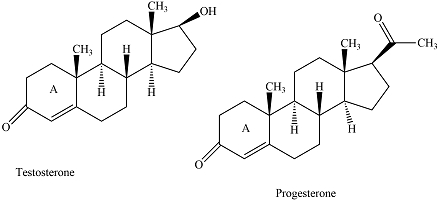
Julian’s work at Glidden was nothing short of revolutionary. He developed a way to mass-produce progesterone and testosterone from soybeans, making hormones that had previously been rare and expensive suddenly affordable and widely available. His synthesis of cortisone from plant sterols dramatically lowered the cost of treating arthritis, putting relief within reach for millions of people.

Cortisone
He also developed a soy-based foam used by the U.S. Navy to extinguish oil and gasoline fires — saving countless lives during World War II. In total, Julian held more than 130 patents.
Honors and Legacy
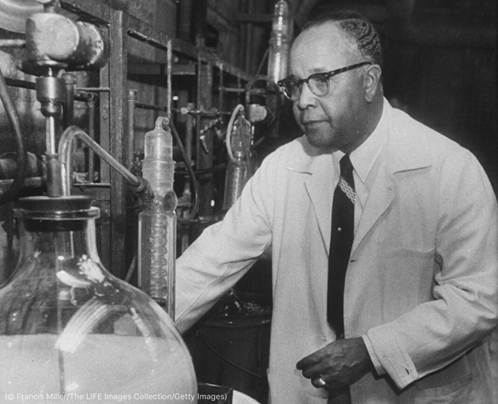
In 1947, Julian founded his own company, Julian Laboratories, becoming one of the first Black Americans to own a pharmaceutical firm. He received the NAACP’s Spingarn Medal in 1947 and was elected to the National Academy of Sciences in 1973, one of the highest honors in American science. In 1990, he was inducted into the National Inventors Hall of Fame.
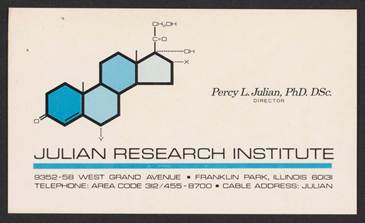
Percy Julian passed away in 1975, but his legacy is very much alive. A Chicago school, a research institute, and a postage stamp all bear his name. More importantly, every person whose arthritis has been treated, every sailor whose life was saved by firefighting foam, carries a small piece of his brilliance.
 Unbedside Manners
Leave a comment