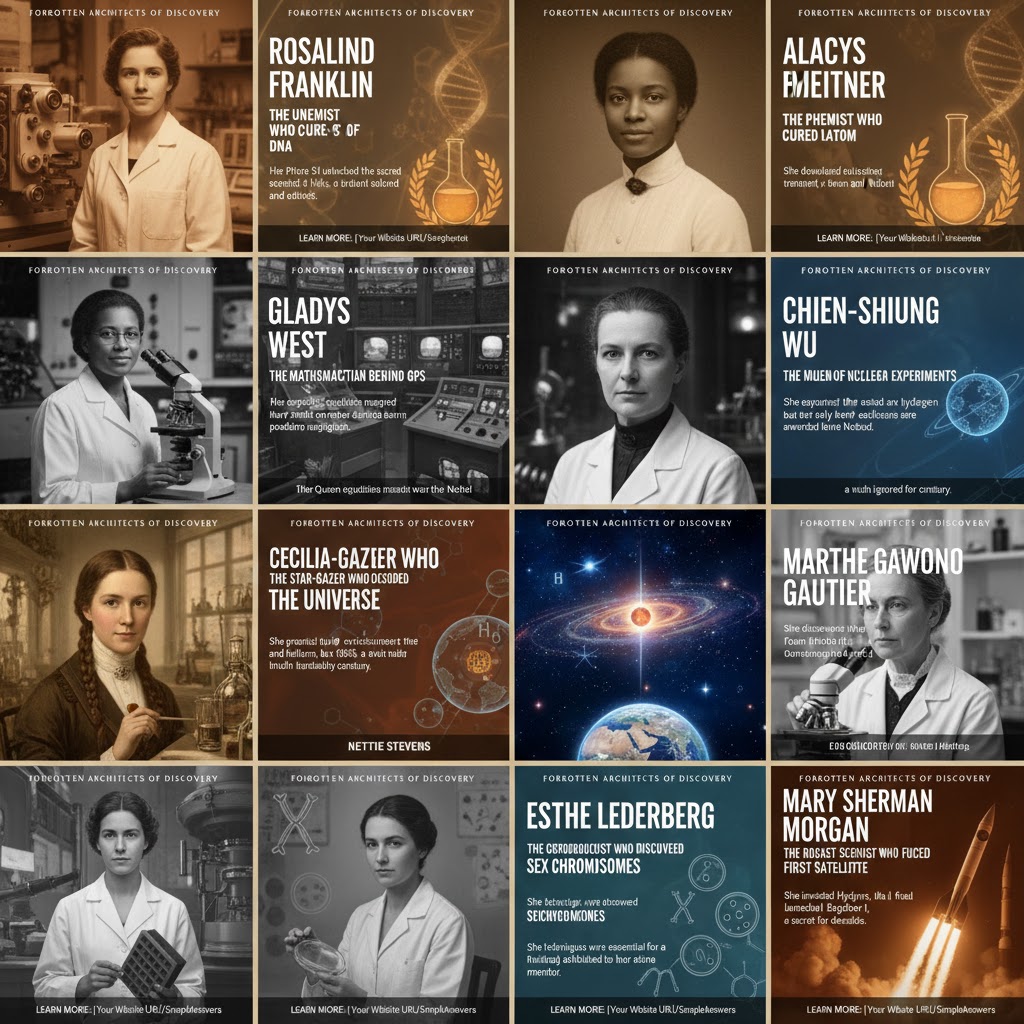
History is often written by those who stay in the room after the work is done, and for centuries, women were systemically ushered out of that room. The stories of these eleven scientists reveal a recurring pattern: a woman performs the grueling laboratory work, achieves a conceptual breakthrough, and then watches as a male colleague—often a mentor or a spouse—claims the accolade.
This phenomenon is known as the Matilda Effect, a term coined by Margaret W. Rossiter to describe the systematic denial of the contributions of women scientists. From the vacuum of space to the microscopic double helix of our own genetic code, these women didn’t just contribute to science; they founded its most critical pillars.
The Anatomy of a “Raw Deal”
The mistreatment of these women typically fell into three categories:
- Intellectual Theft: As seen with Alice Ball and Marthe Gautier, male superiors took raw data or specific methodologies and published them under their own names, banking on the fact that a woman’s claim to the work would be ignored by the academic establishment.
- The “Assistant” Label: Women like Nettie Stevens and Esther Lederberg were often dismissed as mere technicians or “help-mates.” Their labor was seen as mechanical rather than intellectual, allowing men to claim the “visionary” status required for awards like the Nobel Prize.
- Active Exclusion: Chien-Shiung Wu and Lise Meitner faced the double hurdle of sexism and political or ethnic bias. Despite providing the experimental proof for world-altering theories, the Nobel committees simply chose to look the other way, rewarding their male peers instead.
Why Their Stories Matter Today
For many of these women, recognition came far too late. Eunice Newton Foote lay forgotten for 150 years before a retired geologist happened upon her paper in a 2010 search, finally giving her the credit for discovering the greenhouse effect. Gladys West lived long enough to see her work on GPS celebrated, but only after she reached her late eighties.
By telling these stories, we do more than just correct the record; we challenge the “Great Man” theory of history. These women succeeded despite being barred from universities, denied funding, and ignored by journals. Their genius was not just in their discoveries, but in their resilience. As we move forward, acknowledging their work ensures that the next generation of scientists is judged by the quality of their data, not the gender of the researcher.
More stories at www.bedsidemanners.com
 Unbedside Manners
Leave a comment